

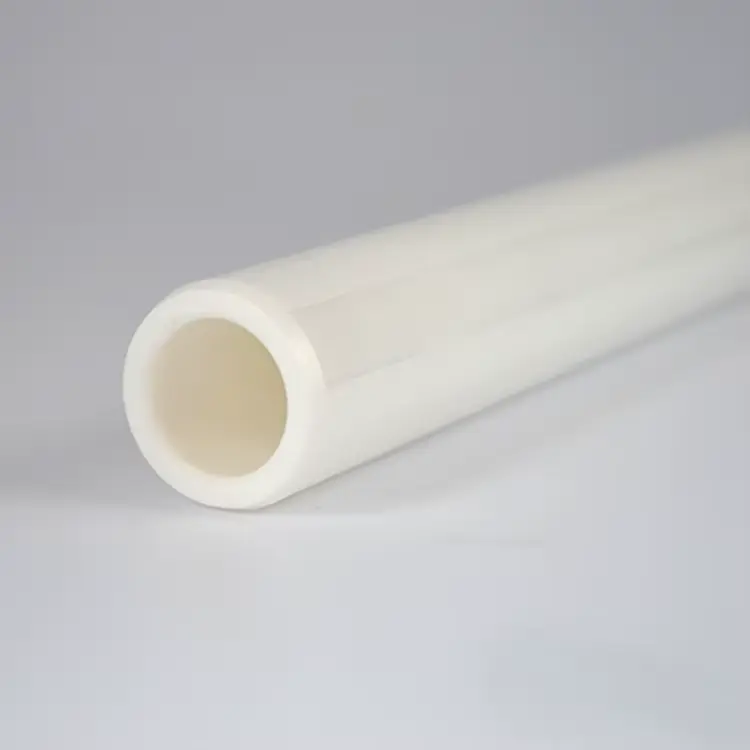
Industrial components are often expected to perform reliably despite exposure to heat, friction, chemical substances, or electrical conditions that can challenge conventional materials. In these environments, material selection becomes a central part of equipment design. Zirconia ceramic is used in selected applications because certain grades combine useful mechanical strength, wear resistance, and thermal characteristics. Formed as a tube, it can provide a protective, insulating, or process-contact component for specialized industrial systems.
The suitability of a Zirconia Ceramic Tube depends on the precise grade and the conditions it will encounter. Engineers should evaluate operating temperature, thermal cycling, chemical exposure, mechanical support, and dimensional requirements before choosing a ceramic tube. Its advantages are meaningful only when the component is matched to the application.
Strength and toughness for demanding service
Ceramics are often associated with hardness and brittleness, but zirconia has a distinctive position among engineering ceramics. Certain stabilized grades offer relatively high fracture toughness compared with many other ceramic materials. This can improve resistance to crack growth under suitable conditions.
Zirconia may be useful where a component experiences mechanical contact, wear, or repeated loading. In tubular form, it can provide a hard surface around a passage or act as a protective sleeve between different materials.
The design still needs to account for ceramic limitations. A tube can be damaged by impact, bending, uneven clamping, or concentrated loads. Its support arrangement should distribute forces appropriately, and installation should avoid point contact or excessive tightening.
Performance in elevated-temperature environments
Some zirconia formulations retain useful properties at elevated temperatures, which can make them relevant to thermal equipment and specialized industrial processes. Their suitability depends on the grade, temperature range, atmosphere, and duration of exposure.
Thermal expansion and temperature gradients must be considered. If a tube is heated unevenly or exposed to rapid temperature changes, internal stresses may develop. These stresses can contribute to cracking, especially where the component is constrained by a metal housing or another material with a different expansion rate.
Designers should review heating and cooling cycles, clearances, support materials, and the manufacturer’s recommended operating limits. A material’s maximum temperature rating should not be treated as a complete guarantee of performance under all thermal conditions.
Chemical and environmental resistance
Zirconia can provide useful chemical resistance in selected environments, but compatibility is specific to the material grade and process conditions. Aggressive chemicals, high concentrations, elevated temperatures, and prolonged exposure can change the performance of some ceramics.
The process fluid or atmosphere should be identified before procurement. Engineers should consider not only the main chemical but also cleaning agents, reaction products, and any contaminants that may contact the tube. Supplier data and application-specific testing are especially important where chemical exposure is severe.
Electrical and insulating applications
Certain zirconia ceramic grades offer electrical insulation properties that can be useful in specialized assemblies. A tube may serve as an insulating sleeve or protective element around a sensor, conductor, or other component.
Electrical behavior can vary with temperature, composition, and environmental conditions. Where insulation is critical, designers should request relevant electrical property data and verify that the selected grade meets the application’s requirements.
Geometry and manufacturing accuracy
Tubular components often need close dimensional control to fit into an assembly or maintain a defined passage. Important dimensions include internal diameter, external diameter, wall thickness, length, straightness, and end configuration.
Zirconia ceramic tubes are formed from ceramic powder and fired to develop their final structure. The firing process involves shrinkage, so manufacturing dimensions must account for the material’s behavior. Grinding or other finishing operations may be used where tighter dimensional tolerances or smoother surfaces are required.
Inspection should cover the features that affect assembly and performance. Visual examination can identify surface damage, while dimensional checks confirm fit. Additional material or mechanical testing may be appropriate for critical uses.
Where industrial designers use zirconia tubes
Applications can include thermal equipment, chemical processing, laboratory systems, electrical assemblies, sensor protection, and wear-related mechanisms. In one system, the tube may separate a sensitive component from a harsh environment. In another, it may provide a stable passage or insulating barrier.
The function determines the necessary material characteristics. A tube selected for electrical insulation may need a different specification from one exposed to abrasive particles or high thermal cycling.
Installation and service-life planning
Ceramic tubes should be handled carefully during storage, transport, and assembly. Surface chips and small cracks can become starting points for failure under load. Appropriate packaging, clean installation surfaces, and compatible supports help reduce damage.
Inspection intervals should reflect the severity of the service environment. Components exposed to impact, vibration, thermal cycling, or abrasive contact may need more frequent examination than those used in stable, protected assemblies.
Choosing zirconia with the application in mind
Zirconia ceramic tubes are used in demanding industrial environments because selected grades offer a useful combination of mechanical, thermal, and electrical properties. Their performance depends on correct grade selection, sound component geometry, compatible installation, and realistic operating limits. By defining these requirements before purchase, engineers can make a more informed decision and use zirconia where its particular characteristics provide a genuine advantage.
