

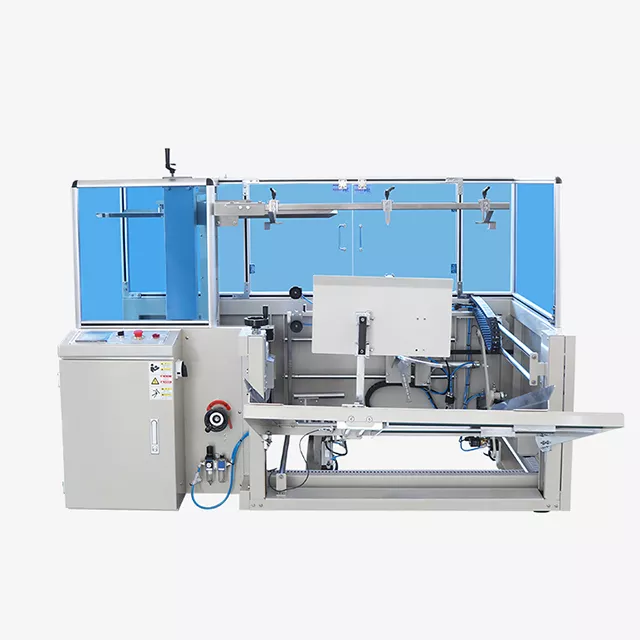
Installing industrial packaging equipment correctly is an important step toward achieving stable and reliable operation. Even a well-designed machine can experience unnecessary downtime if the installation area, utilities, carton supply, or surrounding production line are not properly prepared.
A Case Erecting Machine requires more than simply placing the equipment on the factory floor and connecting the power supply. Its installation should take into account available space, floor conditions, electrical requirements, compressed air, carton handling, safety access, and integration with other packaging equipment.
Assessing the Available Floor Space
Before installation, the available floor area should be measured carefully. The machine needs sufficient space not only for its physical footprint but also for carton loading, product flow, maintenance, and operator access.
Clearance around the equipment is particularly important for servicing components and responding to operational issues. The layout should also avoid creating unnecessary obstacles for workers or nearby machinery.
Checking Floor Conditions
Industrial case erecting equipment should be installed on a suitable, stable surface. An uneven or unsuitable floor can make machine leveling more difficult and may affect alignment.
Before positioning the equipment, the installation team should review the floor’s condition and load-bearing capacity. Any requirements specified by the equipment manufacturer should be followed during preparation.
Electrical Requirements
Electrical power is one of the primary installation considerations. The machine should be connected to an appropriate power supply that matches its specified voltage, frequency, and electrical configuration.
Qualified personnel should handle electrical installation and verify that suitable protection and grounding arrangements are in place. Incorrect electrical connections can cause equipment faults and create safety risks.
Compressed Air Supply
Many industrial case-forming systems use pneumatic components for activities such as carton handling, flap movement, clamping, or other mechanical functions.
The facility should provide compressed air at the pressure and flow rate required by the equipment. Air quality can also matter, as moisture or contaminants may affect pneumatic components over time.
Carton Storage and Feeding Area
The area surrounding the machine should allow operators to supply carton blanks efficiently. Cartons should be stored in a way that protects them from excessive moisture, deformation, dust, and physical damage.
Easy access to the carton supply can reduce unnecessary movement during production. It also helps operators maintain a consistent feeding process.
Positioning the Machine
The machine should be positioned according to the planned packaging-line layout. Its orientation needs to accommodate carton entry and the movement of formed cases toward the next stage.
If the equipment connects to conveyors, fillers, sealers, or other machinery, the transfer points should be considered before final positioning. Proper alignment can help reduce product-flow problems.
Connecting to Downstream Equipment
A case erector often operates as part of a larger packaging system. During installation, manufacturers should determine how the equipment will communicate with connected machinery.
Electrical signals, sensors, conveyors, and control interfaces may need to be coordinated so that cases are supplied when downstream equipment is ready. Good integration can prevent unnecessary accumulation or gaps in production.
Safety and Operator Access
Safety should be considered throughout the installation process. Guards, emergency-stop devices, access doors, and other protective features need to remain accessible and functional.
Operators should also have enough room to perform normal tasks without entering unnecessary hazardous areas. Safety procedures should be established before the machine enters regular production.
Environmental Conditions
The installation environment can influence equipment performance and carton quality. Excessive dust, humidity, temperature fluctuations, or other unfavorable conditions may affect mechanical components or packaging materials.
The equipment should be installed in an environment that meets the manufacturer’s stated operating conditions. Keeping the surrounding area clean can also help reduce contamination of sensors and moving components.
Machine Leveling and Alignment
Proper leveling is an important part of commissioning industrial equipment. The machine should be positioned and aligned according to its installation instructions before production begins.
Accurate alignment can help maintain consistent carton movement and reduce mechanical stress. Any connected conveyors should also be checked to ensure that cases transfer smoothly between equipment.
Pre-Production Testing
The installation should be followed by a controlled testing period. Representative carton blanks can be run through the machine to confirm feeding, opening, squaring, bottom folding, and transfer performance.
Testing should also verify that connected equipment responds correctly and that safety systems operate as intended.
A useful pre-production checklist may include:
- Electrical connections verified
- Compressed air supply checked
- Machine leveled and aligned
- Carton specifications confirmed
- Sensors tested
- Safety devices checked
- Conveyor connections aligned
- Trial cartons successfully processed
Operator Training
Installation is not complete until operators understand how to use the equipment safely and correctly. Training should cover normal operation, carton loading, format adjustments, alarm responses, cleaning, and basic troubleshooting.
Maintenance personnel may require additional training covering inspections, lubrication where applicable, component replacement, and control-system procedures.
The Role of Techflow Pack
When planning an industrial case erector installation, businesses should coordinate with the equipment supplier and relevant facility teams early in the process. Reviewing technical specifications before delivery can help identify utility, layout, and integration requirements in advance.
Careful preparation can make commissioning more efficient and reduce the likelihood of installation-related delays.
Preparing for Reliable Operation
Successful installation provides the foundation for dependable case-forming performance. Suitable floor space, utilities, carton storage, safety access, machine alignment, and line integration all contribute to a stable operating environment.
By addressing these requirements before production begins, manufacturers can reduce avoidable installation problems and give their case erecting equipment a better foundation for consistent long-term operation.
