

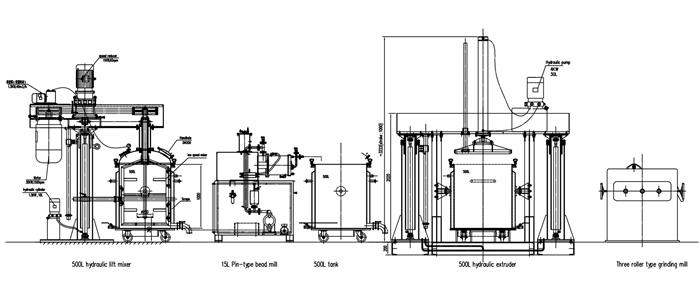
Ink manufacturing is a technically demanding process that requires precise control over dispersion, viscosity, and particle size distribution. Industries such as packaging, publishing, textiles, and digital printing depend on high-quality inks to ensure consistent performance and visual accuracy. However, achieving this consistency is not always straightforward, as several production challenges can arise during formulation and processing.
Modern Ink Production Machine systems are designed to address these challenges by improving efficiency, stability, and quality control throughout the manufacturing process. Ink Production Machine solutions integrate mixing, grinding, and dispersion technologies to ensure reliable and repeatable results in industrial ink production.
Challenge: Poor Pigment Dispersion
One of the most common issues in ink production is incomplete pigment dispersion. Poor dispersion leads to uneven color distribution, reduced opacity, and inconsistent print quality.
How machines solve it:
Advanced dispersing and grinding systems use high-shear forces and precision milling technology to break down pigment agglomerates. This ensures:
- Uniform particle distribution
- Improved color strength
- Stable and smooth ink texture
Bead mills and high-speed dispersers are especially effective in solving this issue.
Challenge: Inconsistent Viscosity
Maintaining consistent viscosity is essential for proper ink flow and printability. Variations in viscosity can lead to printing defects such as streaking or smudging.
How machines solve it:
Modern production systems include automated mixing and monitoring tools that regulate viscosity in real time. These systems:
- Maintain stable mixing ratios
- Adjust processing parameters automatically
- Ensure uniform batch-to-batch consistency
This results in better control over ink application performance.
Challenge: Air Bubble Formation
Air entrapment during mixing can negatively affect ink quality, leading to surface defects and unstable printing results.
How machines solve it:
Vacuum deaeration systems integrated into production lines remove trapped air efficiently. These systems help:
- Eliminate air bubbles from ink mixtures
- Improve density and stability
- Enhance final print quality
This is especially important for high-precision printing applications.
Challenge: Particle Size Variability
Uneven particle size distribution can affect ink performance, causing poor color reproduction and reduced stability over time.
How machines solve it:
High-performance grinding equipment ensures controlled particle size reduction. Bead mills and advanced milling systems provide:
- Nano and micron-level grinding precision
- Consistent particle size distribution
- Improved long-term stability of ink formulations
This is critical for premium printing applications.
Challenge: Material Waste and Inefficiency
Traditional ink production methods often result in material loss, inefficiency, and longer processing times.
How machines solve it:
Automated and optimized production systems improve efficiency by:
- Reducing manual handling errors
- Optimizing material usage
- Streamlining multi-stage processing
This leads to lower production costs and higher output efficiency.
Challenge: Equipment Wear and Maintenance Issues
Continuous operation can cause wear and tear on mechanical components, leading to frequent maintenance and downtime.
How machines solve it:
Modern ink production systems are designed with durable materials and improved engineering to reduce wear. They also offer:
- Wear-resistant components
- Easy maintenance access
- Predictive maintenance features
This extends machine lifespan and reduces operational disruptions.
Challenge: Scaling Production Consistently
Scaling from small batches to large-scale production often leads to quality inconsistencies if processes are not well-controlled.
How machines solve it:
Integrated production systems ensure smooth scalability by:
- Maintaining consistent process parameters
- Supporting continuous production lines
- Ensuring uniform quality across different batch sizes
This helps manufacturers meet growing demand without compromising quality.
Conclusion
Ink production involves multiple technical challenges, from pigment dispersion and viscosity control to scalability and equipment maintenance. However, modern technology has significantly improved how these challenges are managed.
By using advanced Ink Production Machine systems, manufacturers can achieve higher efficiency, better consistency, and improved product quality. These solutions not only streamline production but also ensure long-term reliability in demanding industrial environments.
