

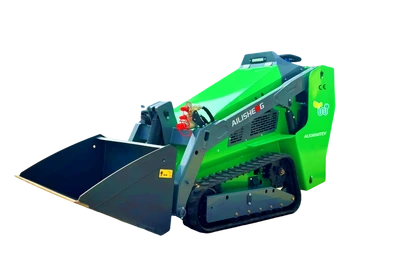
Electric construction equipment is becoming an increasingly practical option for contractors, warehouse operators, landscapers, and material-handling businesses. As battery-powered machinery develops, two equipment types are attracting attention: electric skid loaders and electric wheel loaders. Although both machines can move materials, lift loads, and support demanding jobs, they differ in design, maneuverability, operating capacity, and ideal applications.
Choosing between an Electric Skid Loader and an electric wheel loader depends on the working environment, material-handling requirements, available space, and expected workload. Understanding these differences helps businesses select equipment that delivers the right balance of productivity, operating cost, and versatility.
What Is an Electric Skid Loader?
An electric skid loader is a compact, battery-powered machine designed for lifting, carrying, pushing, and moving materials in relatively confined spaces. Its skid-steer design allows the left and right sides of the machine to operate at different speeds, enabling it to turn within a very small area.
This maneuverability makes electric skid loaders useful for construction sites, landscaping projects, indoor renovation, agricultural facilities, and warehouse operations. Depending on the model, they can work with attachments such as buckets, forks, augers, sweepers, and other compatible tools.
Electric power eliminates tailpipe exhaust during operation and can reduce noise compared with conventional diesel equipment. These characteristics are particularly valuable in enclosed or noise-sensitive environments, provided the machine’s capacity and safety requirements suit the application.
What Is an Electric Wheel Loader?
An electric wheel loader is a battery-powered material-handling machine that typically uses four wheels and an articulated steering system. It is designed primarily for loading, carrying, and transporting bulk materials such as soil, sand, gravel, aggregates, and construction debris.
Electric wheel loaders are available in different sizes, from compact models for smaller sites to larger machines intended for demanding material-handling operations. Their design often emphasizes bucket capacity, traction, stability, and efficient movement between loading and dumping locations.
Many electric wheel loaders are suited to applications where materials need to be transported over greater distances than those commonly covered during compact, confined-space tasks. However, actual capabilities vary significantly by model, so operating capacity, bucket size, and travel performance should always be checked against manufacturer specifications.
1. Key Design Differences
The most noticeable difference between these machines is their steering and turning mechanism.
An electric skid loader turns by varying the speed and direction of its left and right wheels or tracks. This allows it to pivot within a small footprint, making it especially useful in tight work areas. However, skid steering can scrub tires or tracks against the ground during turns, which may increase wear on some surfaces.
An electric wheel loader typically steers through an articulated joint between its front and rear sections. The front and rear frames pivot relative to each other, allowing the machine to turn while maintaining a more conventional wheeled movement pattern.
This design difference influences how each machine performs in restricted spaces, on larger work areas, and during repeated loading cycles.
2. Maneuverability and Working Space
Maneuverability is often a deciding factor when choosing between an electric skid loader and an electric wheel loader.
Electric Skid Loader
Electric skid loaders are particularly useful where space is limited. Their compact dimensions and tight turning ability allow operators to work around walls, stored materials, vehicles, and other obstacles.
They can be suitable for indoor demolition cleanup, small construction projects, landscaping, and narrow access routes. Track-equipped versions may also offer benefits on certain soft or uneven surfaces, depending on their design and ground conditions.
Electric Wheel Loader
Electric wheel loaders generally need more space to complete turning and loading movements, although compact models can still operate effectively in restricted areas.
Their articulated steering is useful for maneuvering around stockpiles, loading vehicles, and moving material across open work areas. For operations involving repeated travel between loading and unloading points, this steering design may offer practical advantages.
Which is better? An electric skid loader is often the stronger option for tight spaces and frequent direction changes. An electric wheel loader may be more suitable when the work area provides enough room for efficient loading and material transport.
3. Lifting Capacity and Material Handling
Both machines can lift and move materials, but their capabilities depend on size, design, hydraulic performance, and rated operating specifications.
Electric skid loaders are versatile machines for carrying loads over short distances and performing tasks with different attachments. They can handle soil, construction debris, pallets, and other materials when the load remains within the machine’s rated capacity.
Electric wheel loaders are commonly designed around bucket-based material handling. Their configuration may provide advantages when loading bulk materials repeatedly or transporting substantial quantities between locations.
However, neither machine type is universally more powerful. A larger electric skid loader may outperform a smaller wheel loader in certain tasks, while a suitably sized wheel loader may move greater quantities of bulk material more efficiently.
Before purchasing either machine, compare rated operating capacity, tipping load, lift height, breakout force, bucket capacity, and hydraulic specifications. These figures provide a more reliable basis for selection than machine category alone.
4. Battery Runtime and Charging Requirements
Because both machines rely on rechargeable batteries, their operating time depends on usable battery capacity and average energy consumption.
The amount of energy required varies according to workload, travel distance, terrain, attachment use, ambient temperature, and operating technique. Repeated heavy lifting or continuous hydraulic work can consume more energy than lighter tasks.
Electric Skid Loader Runtime
An electric skid loader may use energy rapidly during demanding lifting, pushing, or attachment operations. However, its compact design and shorter travel distances can be advantageous in applications where it mainly performs localized tasks.
Electric Wheel Loader Runtime
An electric wheel loader may spend more time transporting materials, loading buckets, and traveling between work areas. Its energy requirements depend on machine size, load weight, travel distance, and the efficiency of its electric drive and hydraulic systems.
Contractors should not assume that either machine will run longer simply because of its category. The most useful comparison includes usable battery capacity, estimated energy consumption per hour, charging time, and expected runtime under a representative work cycle.
Charging infrastructure should also be considered. Sites with convenient overnight charging or planned charging breaks may find battery-powered equipment easier to integrate into daily operations.
5. Operating Costs and Maintenance
Electric skid loaders and electric wheel loaders can both reduce certain expenses associated with diesel-powered machinery. Electric drives eliminate combustion-engine oil changes and diesel fuel-filter servicing, while electricity may cost less than diesel fuel per unit of useful work.
Nevertheless, electric equipment still requires maintenance. Tires or tracks, hydraulic systems, electrical components, cooling equipment, safety systems, and attachments need inspection and servicing. Battery condition and eventual replacement costs should also be included in long-term ownership estimates.
The relative operating cost of a skid loader versus a wheel loader depends on how each machine is used. A machine that completes the required work with fewer operating hours or less energy consumption may deliver a lower cost per task.
To compare models effectively, evaluate:
- Purchase price and financing costs.
- Electricity consumption under typical workloads.
- Routine maintenance and parts expenses.
- Battery warranty and replacement provisions.
- Charging equipment and installation costs.
- Productivity and potential downtime.
- Expected resale value.
A total cost of ownership analysis helps determine which machine offers the best financial value for a specific business.
6. Attachment Versatility
Attachment compatibility is an important consideration when equipment must perform several types of work.
Electric Skid Loader Attachments
Skid loaders are widely valued for their attachment versatility. Depending on the model and hydraulic configuration, they may support buckets, pallet forks, augers, trenchers, sweepers, grapples, and other specialized tools.
This flexibility can allow one compact machine to support several tasks throughout a project. However, operators must verify attachment compatibility, hydraulic flow and pressure requirements, electrical connections where applicable, and rated load limits.
Electric Wheel Loader Attachments
Electric wheel loaders commonly use buckets for moving and loading bulk materials. Some models can also accommodate forks, grapples, and other tools, depending on the machine’s coupler and hydraulic configuration.
Their attachment range is model-specific, so buyers should confirm which tools are approved by the manufacturer rather than assuming that every attachment will fit.
Which is better? An electric skid loader may be preferable for contractors who frequently switch between diverse tasks in confined areas. An electric wheel loader can be a strong choice for businesses focused on repeated bucket loading and material transport.
7. Traction, Stability, and Ground Conditions
Ground conditions affect productivity, safety, and energy consumption for both equipment types.
Electric skid loaders may be available with wheels or tracks. Wheeled models can work well on firm surfaces, while track-equipped models may provide better flotation and traction on selected soft or uneven surfaces. The actual result depends on ground pressure, track design, machine weight, and site conditions.
Electric wheel loaders generally use a four-wheel configuration designed for traction and stability during material handling. Their performance depends on tire selection, axle design, load distribution, and the surface on which they operate.
When working on slopes or uneven ground, contractors should follow the manufacturer’s operating limits and use the machine only under suitable conditions. Load stability, visibility, travel speed, and braking performance are important regardless of equipment type.
8. Indoor Work and Environmental Considerations
Both electric skid loaders and electric wheel loaders can offer environmental and workplace advantages compared with equivalent diesel machines.
Because they produce no tailpipe exhaust while operating, electric models can reduce local combustion emissions. Their quieter operation may also make them attractive for warehouses, manufacturing facilities, renovation projects, and sites with noise restrictions.
Electric skid loaders often have an advantage in smaller indoor areas because of their compact dimensions and maneuverability. Electric wheel loaders may be suitable for larger industrial facilities, recycling operations, and indoor bulk-material handling where sufficient space is available.
However, battery-powered equipment is not automatically suitable for every enclosed environment. Operators must consider battery safety, ventilation requirements, charging arrangements, floor load limits, pedestrian separation, and the facility’s operating rules.
Environmental benefits also depend on how the electricity is generated and the equipment’s full lifecycle, including battery production and eventual disposal or recycling.
9. Productivity and Job-Site Efficiency
Productivity depends on how effectively a machine completes the required tasks, not simply on its power source.
An electric skid loader may improve efficiency when operators need to maneuver frequently, change attachments, or perform several different jobs in a small area. Its compact layout can reduce the need for larger equipment on some projects.
An electric wheel loader may deliver better productivity when the main task involves loading bulk materials and moving them across an open site. Bucket capacity, travel speed, turning space, and loading-cycle time can all influence how much material the machine handles during a shift.
Contractors should estimate productivity using the actual work cycle. For example, consider the quantity of material moved per hour, the distance traveled, the number of loading cycles, and the time required for repositioning or charging.
A practical demonstration under representative site conditions can help confirm whether a particular machine meets production targets.
10. How to Choose the Right Machine for Your Business
Selecting the right electric loader starts with identifying the most common tasks and the conditions in which the equipment will operate.
Consider the following factors before making a decision:
- Available workspace: Tight access and frequent turns may favor an electric skid loader.
- Material-handling requirements: Repeated bulk loading and transport may favor a suitably sized electric wheel loader.
- Load capacity: Compare rated operating capacity, tipping load, and bucket capacity with the materials being handled.
- Travel distance: Consider how far materials must be moved during each work cycle.
- Attachment needs: Confirm compatibility with the tools required for daily operations.
- Battery and charging: Check expected runtime, charging time, and electrical supply.
- Ground conditions: Assess traction, surface protection, and maneuverability requirements.
- Ownership costs: Compare purchase price, energy use, maintenance, battery expenses, and resale value.
It is also important to consider local service support, parts availability, warranty terms, and operator training. These factors can influence machine availability and the long-term value of the investment.
Electric Skid Loader vs. Electric Wheel Loader: Quick Comparison
| Feature | Electric Skid Loader | Electric Wheel Loader |
|---|---|---|
| Steering design | Skid steering | Typically articulated steering |
| Maneuverability | Excellent in confined areas | Generally better suited to open work areas |
| Typical applications | Landscaping, indoor construction, cleanup, versatile site work | Bulk-material handling, stockpiles, loading and transport |
| Common material-handling approach | Bucket and interchangeable attachments | Primarily bucket-based loading |
| Attachment flexibility | Often broad, depending on model | Varies by model and coupler |
| Battery runtime | Depends on capacity and workload | Depends on capacity and workload |
| Best selection criteria | Space, versatility, and task variety | Material volume, loading cycles, and travel distance |
These are general comparisons. Individual models can differ substantially in dimensions, rated capacity, battery technology, hydraulic output, and performance.
Frequently Asked Questions
Is an electric skid loader better than an electric wheel loader?
Neither is universally better. An electric skid loader is often more suitable for compact work areas and diverse tasks, while an electric wheel loader may be better for repeated bulk-material loading and transport. The right choice depends on the job.
Which machine is better for indoor construction?
An electric skid loader is often a practical choice for confined indoor projects because of its compact design and tight turning ability. A compact electric wheel loader may also work well in larger facilities where there is enough space for maneuvering.
Which machine has a longer battery runtime?
Runtime depends on battery capacity, average energy consumption, workload, terrain, and operating conditions. Compare manufacturer specifications and realistic work-cycle data rather than assuming that one machine type always lasts longer.
Are electric wheel loaders more powerful than electric skid loaders?
Not in every case. Performance depends on the individual machine’s motor output, hydraulic system, rated capacity, and design. Compare technical specifications to determine which model can safely complete the intended tasks.
Which machine is more economical to operate?
Both can offer energy and maintenance advantages over diesel equipment. The more economical option depends on electricity prices, utilization, maintenance requirements, productivity, battery expenses, and the total cost of ownership.
Conclusion
Electric skid loaders and electric wheel loaders serve overlapping but distinct roles in modern material handling and construction. Electric skid loaders stand out for compact maneuverability and attachment versatility, making them attractive for confined spaces and varied tasks. Electric wheel loaders are commonly suited to bulk-material handling, repeated bucket loading, and transporting materials across larger work areas.
The best investment is the machine that matches the site’s space, workload, material volume, and charging capabilities. By comparing operating specifications, battery performance, attachment compatibility, productivity, and long-term ownership costs, contractors can select electric equipment that meets their operational needs and supports efficient project delivery.
