

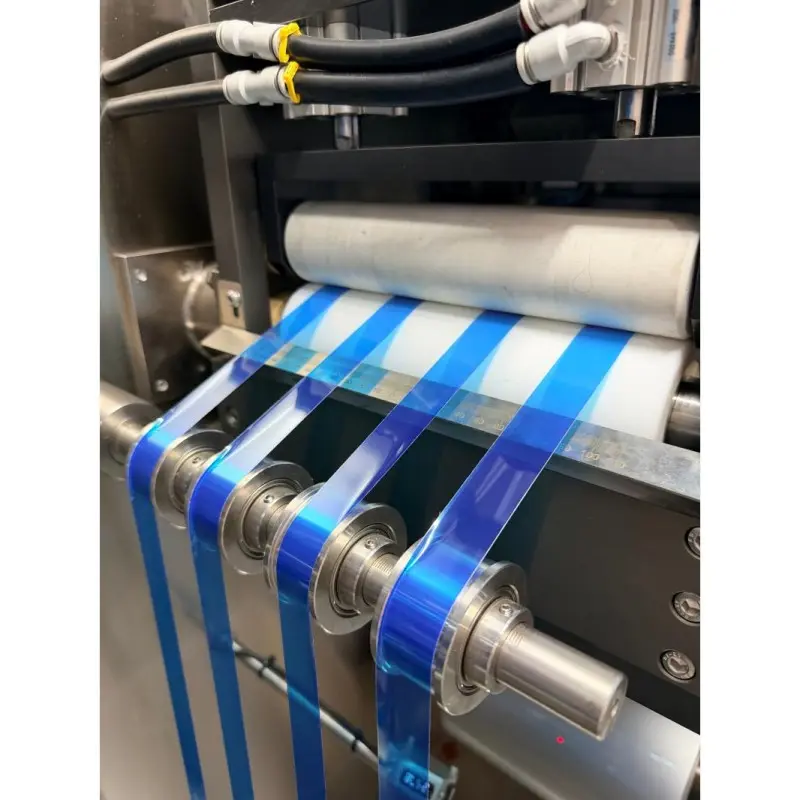
Industrial packaging operations often require automated equipment capable of handling water-soluble film consistently across forming, filling, sealing, and finished-pouch handling stages. The specific equipment configuration depends on the product, film characteristics, pouch format, and required production capacity.
Choosing suitable Water Soluble Film Equipment starts with understanding the different systems available and how each one contributes to the packaging process. Different applications may require simple single-format equipment or more advanced systems with multiple functions.
Automatic Water Soluble Pouch Machines
Automatic pouch machines integrate several packaging functions into one production system. They can feed film, form pouches, dispense products, seal packages, and separate finished units.
These machines are suitable for industrial environments where repeatable production and reduced manual handling are important. Their configuration can vary according to the required pouch size, product type, and production speed.
Liquid Filling Equipment
Liquid products require filling systems capable of controlling volume and preventing unnecessary product movement around the sealing area.
Pumps, valves, filling nozzles, and dosing controls can be configured according to the viscosity and flow characteristics of the formulation. Accurate liquid filling helps maintain consistent pouch weights and minimize product waste.
Powder Dosing Equipment
Powder formulations require dosing systems designed for their specific flow properties. Particle size, bulk density, moisture content, and flowability can all affect dosing consistency.
Industrial powder packaging systems may use specialized auger, volumetric, or other dosing technologies. The selected system should be tested with the actual formulation to verify filling performance.
Granule Filling Systems
Granular products can have different flow characteristics from powders and liquids. Their particle size and density can influence how consistently they move through the dosing equipment.
Granule filling systems are therefore selected according to the physical properties of the product. Consistent feeding and controlled dosing help maintain uniform quantities in finished pouches.
Viscous Product Filling Equipment
Gels, pastes, and other viscous formulations can require specialized filling mechanisms. Their resistance to flow may affect pumping speed, nozzle design, and dosing accuracy.
Controlled filling is especially important when the product must remain away from the sealing area. Equipment trials can help determine appropriate filling parameters for the formulation.
Multi-Chamber Packaging Equipment
Some industrial applications require multiple product components to remain separated within a single pouch. Multi-chamber packaging equipment forms separate compartments and fills them individually.
This configuration can be useful for products containing components that should not be mixed until use. Accurate forming and filling are necessary to maintain separation between chambers.
High-Speed Packaging Systems
High-output manufacturing operations may require equipment designed for continuous, high-speed pouch production. These systems coordinate film movement, filling, sealing, and cutting at controlled production rates.
Actual output depends on factors such as pouch dimensions, filling volume, product properties, film behavior, and machine settings. Manufacturers should evaluate practical production capacity rather than relying only on theoretical cycle speed.
Film Feeding and Handling Equipment
Film-handling systems control how water-soluble material moves through the packaging machine. Components can include roll holders, guide rollers, tension controls, and positioning mechanisms.
Stable film movement is essential for maintaining pouch alignment. Poor tension or tracking can result in wrinkles, dimensional variation, or sealing problems.
Forming Equipment
Forming systems shape the film before or during product filling. Their design determines the dimensions and structure of the resulting pouch.
Forming components must be compatible with the selected film and pouch design. Correct alignment and regular inspection can help maintain consistent package dimensions.
Heat Sealing Equipment
Sealing systems create the closed package after filling. Depending on the film and machine design, sealing may involve controlled temperature, pressure, and dwell time.
The sealing process needs to be consistent across production cycles. Operators should monitor sealing conditions and keep sealing surfaces clean to reduce the risk of package defects.
Cutting and Separation Equipment
Cutting systems separate finished pouches from one another or divide connected package arrangements into individual units.
Cutting accuracy is important for consistent pouch dimensions and clean package edges. Wear on blades or other separation components can affect performance over time.
Temperature Control Systems
Packaging machines that use heat during sealing require appropriate temperature-control components. These can include heating elements, sensors, controllers, and monitoring interfaces.
Maintaining stable temperature conditions can help support repeatable sealing performance. Temperature settings should be established according to the selected film and validated production process.
Automated Control Systems
Industrial equipment increasingly incorporates centralized control systems to coordinate different machine functions. Operators can use these systems to manage approved parameters and monitor machine status.
Depending on the equipment, control functions may include alarm monitoring, sensor feedback, production counters, and parameter storage. Automation can also simplify repeatable production settings.
Inspection Equipment
Quality-control systems can be integrated into industrial packaging lines to identify problems with finished pouches. Inspection may include checks for dimensions, filling consistency, sealing quality, and package appearance.
The appropriate inspection approach depends on product requirements and quality standards. Automated inspection can be particularly useful for high-volume operations.
Downstream Packaging Equipment
After individual pouches are produced, additional equipment may be required for counting, collection, secondary packaging, or transfer to other production stages.
The downstream system should handle finished pouches carefully. Storage and transport conditions may also need to account for the moisture sensitivity of water-soluble film.
Supporting Utility Systems
Industrial packaging equipment can depend on supporting utilities such as electricity, compressed air, and suitable environmental conditions.
Before installation, manufacturers should confirm available power capacity, air pressure requirements, floor space, ventilation, temperature, and humidity. Proper preparation can make commissioning more efficient.
Selecting Equipment for an Industrial Application
The most appropriate equipment type depends on several factors:
- Product formulation and physical properties
- Film specification
- Required pouch dimensions
- Single- or multi-chamber design
- Filling quantity
- Target production volume
- Environmental conditions
- Automation requirements
- Cleaning and maintenance procedures
- Available technical support
A production trial using the intended product and film can provide useful information about equipment compatibility before a larger investment is made.
POLYVA provides water-soluble film packaging solutions for different industrial packaging requirements, with equipment configurations selected according to application and production needs.
Conclusion
Industrial water-soluble packaging can involve many equipment types, including automatic pouch machines, liquid and powder filling systems, film-handling units, forming and sealing equipment, cutting systems, temperature controls, inspection equipment, and downstream packaging solutions.
The right combination depends on the product, film, pouch design, production volume, and factory environment. Evaluating these requirements together allows manufacturers to develop a packaging line that supports consistent operation and finished-package quality.
