

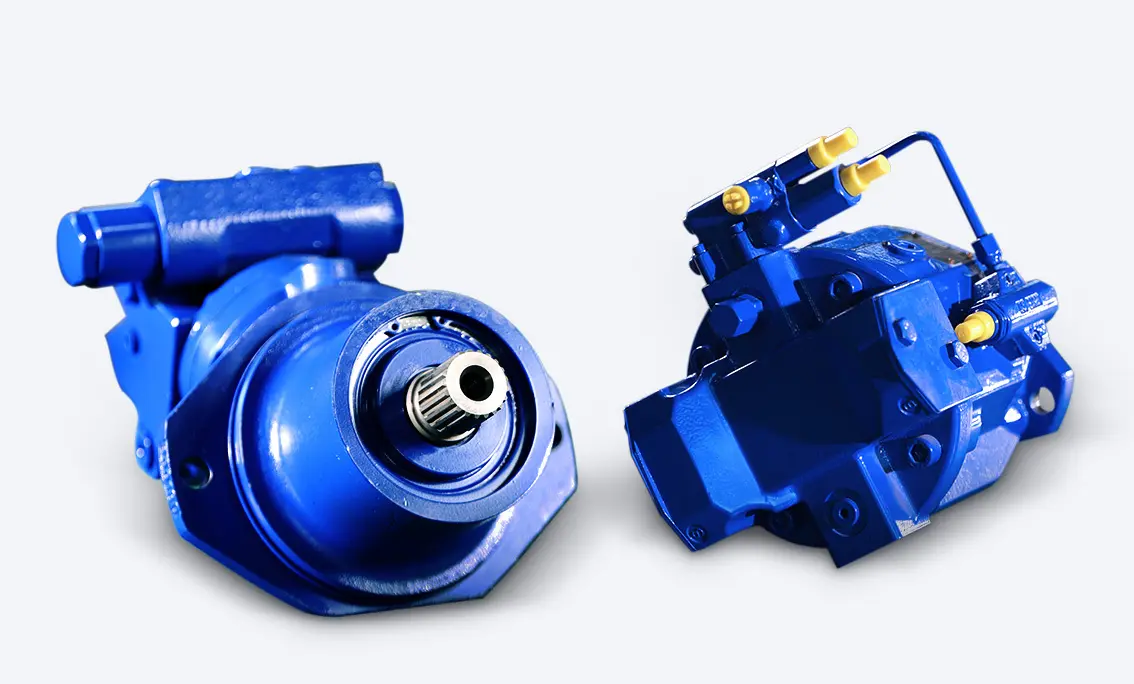
Displacement, torque, and speed are three fundamental specifications used to evaluate hydraulic motor performance. Understanding how they interact helps industrial buyers select a motor that can deliver the required output without placing unnecessary demands on the hydraulic system.
When working with a hydraulic motor manufacturer, buyers should look beyond individual ratings and consider how displacement, pressure, and flow work together. Proper matching of these parameters can improve efficiency, reliability, and overall machine performance.
What Is Hydraulic Motor Displacement?
Motor displacement refers to the volume of hydraulic fluid required to produce one revolution of the motor’s output shaft. It is commonly expressed in cubic centimeters per revolution (cc/rev) or cubic inches per revolution.
A higher-displacement motor generally requires more hydraulic fluid to turn at the same speed as a lower-displacement motor. At a given flow rate, increasing displacement therefore tends to reduce rotational speed while increasing the motor’s potential torque.
Displacement is an important starting point when matching a motor to the available pump flow and required output.
How Displacement Affects Speed
Hydraulic flow has a direct relationship with motor speed. In simplified terms, motor speed increases as available flow increases and decreases as displacement increases.
For example, if two motors receive the same hydraulic flow but one has twice the displacement, the larger-displacement motor will generally rotate at approximately half the speed, assuming similar efficiency.
Actual operating speed can differ because of volumetric losses, pressure, temperature, and other system conditions.
What Is Hydraulic Motor Torque?
Torque is the rotational force produced at the motor shaft. It determines the motor’s ability to turn a load.
Hydraulic pressure has a strong relationship with motor torque. Increasing pressure generally increases available torque, while motor displacement also influences the amount of torque produced for a given pressure.
In practical hydraulic applications, engineers consider both continuous torque and peak torque. Continuous torque describes the output required during normal operation, while peak torque accounts for temporary higher loads.
Understanding Motor Speed
Motor speed is usually measured in revolutions per minute (RPM). It indicates how quickly the output shaft rotates.
Speed is primarily influenced by hydraulic flow and motor displacement. However, load, pressure, efficiency, and operating conditions can also affect actual performance.
A motor selected for high-speed operation should be checked against its recommended speed range rather than relying solely on a theoretical speed calculation.
The Relationship Between Flow and Speed
A basic way to understand the relationship is that hydraulic flow determines how quickly the motor receives the fluid volume needed for rotation.
A motor with smaller displacement can achieve higher speed from a given flow rate. A larger-displacement motor generally turns more slowly under the same flow conditions but can provide greater torque.
This relationship allows engineers to select different motor configurations for high-speed or high-torque applications.
The Relationship Between Pressure and Torque
Hydraulic pressure is closely associated with torque output. When system pressure rises, the motor can generally produce greater torque, provided it remains within its specified operating range.
However, maximum pressure should not be treated as a target operating condition. Continuous pressure ratings, peak pressure ratings, and actual application requirements all need to be considered.
Operating above the manufacturer’s specified limits can increase wear and reduce service life.
Displacement, Torque, and Speed Work Together
These three parameters should be evaluated as a group rather than independently.
A simplified example illustrates the principle. Suppose an application requires high torque but only moderate rotational speed. A larger-displacement motor operating at an appropriate pressure and flow may be more suitable than a small-displacement motor operating at very high pressure.
Conversely, an application requiring higher speed with relatively modest torque may benefit from a smaller-displacement motor supplied with an appropriate flow rate.
Fixed-Displacement vs. Variable-Displacement Motors
Hydraulic motors can have either fixed or variable displacement.
Fixed-Displacement Motors
A fixed-displacement motor has a predetermined fluid volume per revolution. Its speed and torque characteristics are therefore largely controlled by the hydraulic system’s flow and pressure.
These motors can be suitable for applications with relatively stable operating requirements.
Variable-Displacement Motors
Variable-displacement motors allow displacement to be adjusted within a specified range. This provides greater flexibility in controlling the relationship between speed and torque.
They are often useful in applications where operating conditions change significantly or where both high torque and variable speed are required.
Calculating Theoretical Motor Speed
Engineers can estimate motor speed using the available hydraulic flow and motor displacement.
A simplified relationship is:
Motor speed ≈ Hydraulic flow ÷ Motor displacement
In practice, volumetric efficiency must be considered because some fluid can bypass the motor’s displacement chambers through internal leakage.
Therefore, actual speed may be lower than the theoretical value.
Calculating Theoretical Torque
Theoretical motor torque is related to hydraulic pressure and displacement. In practical calculations, a motor’s mechanical efficiency also needs to be considered.
A larger displacement generally produces more torque at the same pressure. This is one reason high-torque, low-speed applications often use larger-displacement motor designs.
Actual output should always be checked against manufacturer performance data rather than relying solely on simplified calculations.
Why Efficiency Changes the Results
Real hydraulic motors experience both volumetric and mechanical losses.
Volumetric losses can reduce actual speed because some hydraulic fluid leaks internally. Mechanical losses can reduce the torque available at the output shaft because some energy is consumed by friction and other resistance.
As a result, theoretical calculations provide useful estimates, but actual performance should be evaluated under realistic operating conditions.
Matching Motor Specifications to the Pump
The hydraulic motor and pump should be considered together. The pump determines the available flow and pressure, while the motor converts that hydraulic energy into mechanical output.
A mismatch can cause performance problems. For example, insufficient flow may prevent the motor from reaching the required speed, while insufficient pressure may prevent it from producing the required torque.
The complete hydraulic circuit should therefore be evaluated before selecting the motor.
Choosing the Right Displacement
The appropriate displacement depends largely on the required combination of torque and speed.
Consider the following general relationships:
- Higher displacement generally favors higher torque and lower speed.
- Lower displacement generally favors higher speed and lower torque.
- Higher hydraulic flow can increase motor speed.
- Higher hydraulic pressure can increase available torque.
- Efficiency affects the actual speed and torque achieved.
These relationships provide a useful framework for comparing different motor options.
Consider Starting Torque
Starting torque deserves particular attention in applications where the motor must begin rotating under load.
Conveyors, winches, mixers, and heavy mobile equipment can require significant torque during startup. A motor that performs adequately at operating speed may still struggle to start if its available starting torque is insufficient.
Buyers should therefore check starting torque requirements separately from continuous operating torque.
Continuous and Peak Operating Conditions
Industrial machinery rarely operates under exactly one fixed load. Loads can increase temporarily during acceleration, startup, braking, or changes in material conditions.
The motor should be selected with both normal and peak operating conditions in mind.
However, peak ratings generally describe limited operating conditions and should not be interpreted as continuous ratings.
Application Examples
Different equipment types demonstrate how these specifications can be balanced.
Conveyors
Conveyors may require steady torque and controlled speed. Motor selection depends on belt speed, load, acceleration requirements, and available hydraulic flow.
Winches
Winches often require high starting and low-speed torque, particularly when lifting heavy loads. Larger-displacement motors may be considered where these characteristics are required.
Agricultural Machinery
Agricultural equipment can require variable motor speeds and changing torque demands. Motor selection should account for the machine’s hydraulic circuit and changing field conditions.
Construction Equipment
Construction machinery can experience substantial load variations and shock loads. Motors need appropriate pressure, torque, speed, and durability characteristics for the intended machine.
Common Selection Mistakes
One frequent mistake is selecting a motor solely according to maximum pressure. A motor may tolerate high pressure but still be unsuitable if its displacement and speed characteristics do not match the machine.
Another mistake is ignoring starting torque. Applications with heavy starting loads can require substantially different motor characteristics from applications that start without a significant load.
It is also important not to confuse theoretical performance with actual performance. Efficiency and operating conditions can significantly affect real-world output.
Questions to Ask a Hydraulic Motor Supplier
Before purchasing, industrial buyers should request detailed performance information, including:
- What are the fixed or variable displacement options?
- What flow range is recommended?
- What are the continuous and peak pressure ratings?
- What torque is available at different pressures?
- What is the recommended speed range?
- What starting torque can the motor provide?
- What efficiency data is available?
- What hydraulic fluid and temperature ranges are supported?
- Are performance curves available?
- Can the motor be configured for the intended application?
These questions help buyers evaluate motors based on actual operating requirements rather than isolated catalog numbers.
Conclusion
Displacement, torque, and speed are closely connected in hydraulic motor selection. Displacement influences how much flow is required for a given speed and contributes to the torque available at a particular pressure. Flow primarily influences speed, while pressure strongly affects torque.
For reliable equipment performance, these specifications should be evaluated together with efficiency, starting loads, duty cycle, and hydraulic system capacity. A careful selection process allows industrial buyers to choose a motor that delivers the required output while operating within appropriate performance limits.
