

1. Engineering Design and Production Preparation
Before manufacturing begins, engineers analyze the customer’s operating conditions and determine the appropriate slurry pump design.
Important parameters include:
- Slurry type
- Solid particle concentration
- Particle size
- Flow rate
- Head requirement
- Operating temperature
- Corrosive conditions
Based on these requirements, engineers confirm the pump structure, including:
- Impeller design
- Volute liner
- Frame plate liner
- Shaft assembly
- Bearing assembly
Accurate engineering preparation ensures the final pump can achieve stable performance under demanding conditions.
2. Material Selection for Slurry Pump Components
Material selection is one of the most important steps in slurry pump manufacturing.
Because slurry pumps operate in highly abrasive environments, the main wetted components require excellent wear resistance.
Common materials include:
High Chrome Alloy
High chrome alloy is widely used for slurry pump wear parts, such as:
- Impellers
- Volute liners
- Throatbushes
- Frame plate liners
Advantages:
- High hardness
- Excellent abrasion resistance
- Long service life
Natural Rubber
Rubber-lined slurry pumps are suitable for applications involving:
- Fine particles
- Corrosive slurry
- Low-impact conditions
Selecting the correct material according to the slurry characteristics helps improve pump reliability and reduce maintenance costs.
3. Slurry Pump Casting Process
Casting is the foundation of slurry pump manufacturing. The quality of cast components directly affects wear resistance, mechanical strength, and service life.
The main casting process includes:
3.1 Pattern Making and Sand Molding
According to engineering drawings, casting patterns are produced for slurry pump components.
The molding process requires accurate control of:
- Pattern dimensions
- Casting allowance
- Mold quality
- Surface condition
A high-quality mold helps prevent casting defects such as:
- Porosity
- Sand inclusion
- Shrinkage defects
- Cracks
3.2 Alloy Melting
Selected raw materials are added into an electric furnace and melted at high temperatures to produce alloy molten metal.
During melting, manufacturers control:
- Melting temperature
- Chemical composition
- Alloy ratio
For high chrome slurry pump parts, alloy elements such as:
- Chromium (Cr)
- Carbon (C)
- Nickel (Ni)
- Molybdenum (Mo)
are carefully controlled to achieve the required wear performance.
3.3 Molten Metal Chemical Analysis
Before pouring, molten metal is tested to verify the alloy composition.
Advanced inspection equipment, such as optical emission spectrometers, is used to analyze metal elements.
The inspection ensures that the molten alloy meets material specifications before casting.
3.4 Casting Pouring and Cooling
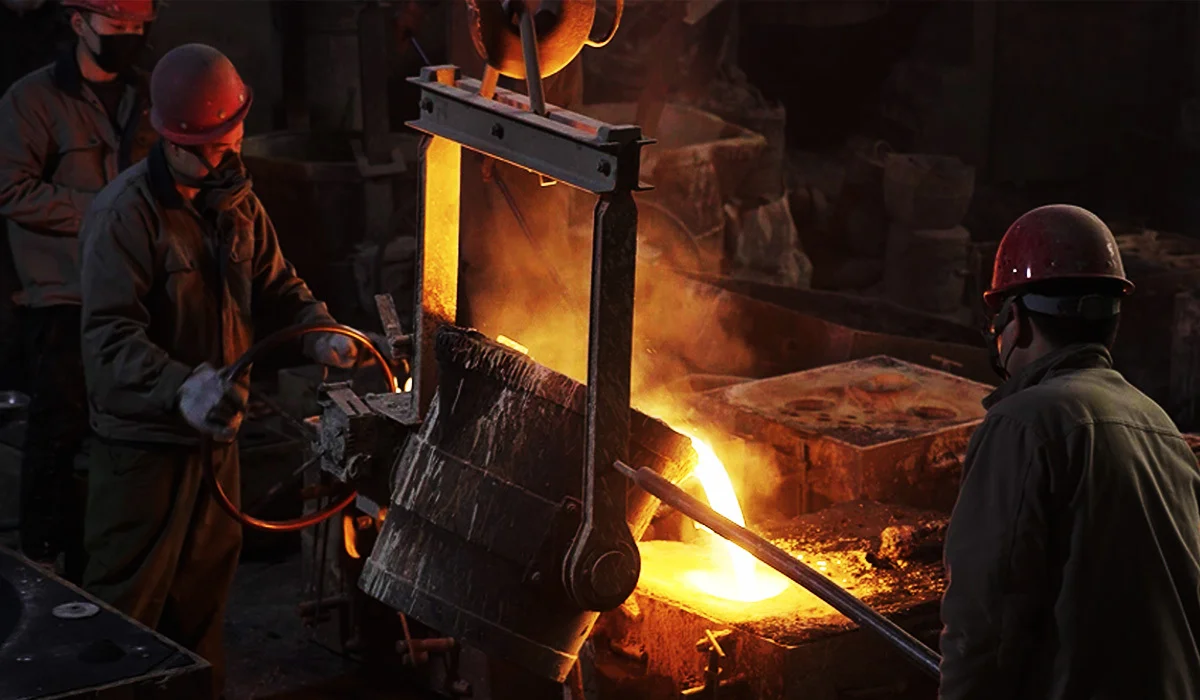
After the molten metal composition is confirmed, it is poured into prepared molds.
The pouring process requires precise control of:
- Metal temperature
- Pouring speed
- Cooling conditions
Proper casting control helps achieve uniform internal structure and reduces manufacturing defects.
3.5 Casting Cleaning and Inspection
After cooling and solidification, cast components undergo:
- Sand removal
- Surface cleaning
- Grinding
Finished castings are inspected through:
- Visual inspection
- Dimension inspection
- Hardness testing
- Material verification
Only qualified castings proceed to the next manufacturing stage.
4. Heat Treatment Process
Heat treatment improves the internal structure and mechanical properties of slurry pump components.
The main purposes include:
- Improving hardness
- Increasing wear resistance
- Reducing casting stress
- Enhancing mechanical performance
Typical heat treatment includes:
Annealing
Used to:
- Reduce internal stress
- Improve machinability
- Prepare components for machining
Rough Machining
After annealing, excess material is removed through rough machining.
Normalizing Treatment
Normalizing improves the alloy structure and enhances:
- Wear resistance
- Strength
- Durability
After heat treatment, components are ready for precision machining.
5. Precision Machining of Slurry Pump Components
Machining determines the final dimensional accuracy of slurry pump parts.
Common equipment includes:
- CNC lathes
- Vertical lathes
- Milling machines
- Boring machines
- Drilling machines
Critical components require precise machining:
Impeller Machining
Controlled parameters include:
- Impeller diameter
- Blade profile
- Flow passage dimensions
Shaft Machining
Controlled parameters include:
- Shaft diameter
- Runout accuracy
- Keyway dimensions
Bearing Assembly Machining
Ensures:
- Accurate fitting
- Proper alignment
- Stable operation
After machining, professional inspectors verify all dimensions according to technical requirements.
6. Slurry Pump Assembly Process
Assembly is the process of combining all components into a complete slurry pump.
Before assembly, technicians check:
- Component condition
- Dimensional accuracy
- Compatibility of parts
The assembly process includes:
- Bearing assembly installation
- Shaft installation
- Impeller installation
- Liner installation
- Sealing system installation
Proper assembly ensures:
- Smooth operation
- Reduced vibration
- Longer service life
7. Slurry Pump Performance Testing and Quality Control
Quality control is an essential part of slurry pump manufacturing.
Before delivery, completed pumps undergo multiple inspections.
Hydraulic Performance Testing
Testing parameters include:
- Flow rate
- Head
- Efficiency
The results are compared with the designed pump performance curve.
Pressure Testing
Used to verify:
- Pump casing strength
- Leakage prevention
Dynamic Balancing
Impellers are dynamically balanced to reduce:
- Vibration
- Noise
- Bearing load
Final Inspection
The final inspection confirms:
- Product appearance
- Assembly quality
- Performance requirements
8. Packaging and Delivery
After final inspection, slurry pumps are prepared for shipment.
Export packaging usually includes:
- Strong wooden cases
- Shock protection
- Moisture protection
Proper packaging ensures the pump arrives safely at the customer’s site.
CNSME Slurry Pump Manufacturing Capability
CNSME is a professional slurry pump manufacturer with more than 20 years of manufacturing experience.
With ISO9001 quality management certification, CNSME controls every production stage, including:
✓ Material selection
✓ Alloy casting
✓ Heat treatment
✓ Precision machining
✓ Assembly
✓ Performance testing
Through strict manufacturing processes and quality control, CNSME provides reliable slurry pumps and replacement spare parts for mining, mineral processing, and industrial applications worldwide.
