

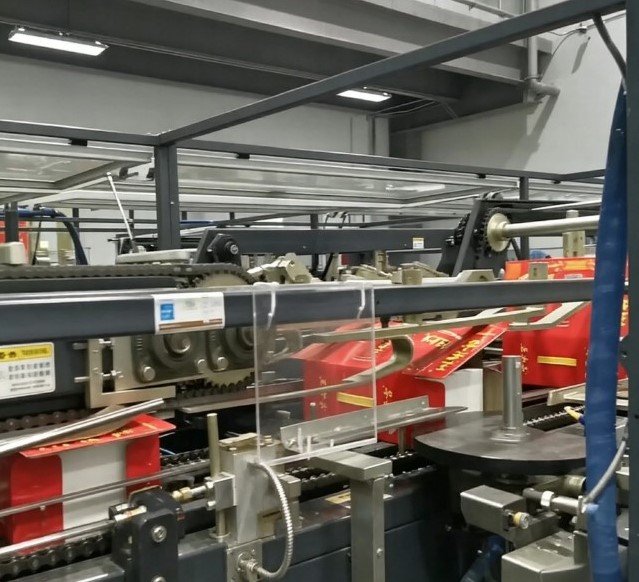
Wrap around packaging refers to a method that uses a flat corrugated cardboard blank to surround a group of products and form a finished case. Unlike conventional cartons that arrive pre-formed, the packaging material takes shape around the products during the packing process.
Manufacturers use this approach for products that need secure secondary packaging for storage, transportation, and distribution. A wrap around packer automates much of this process, helping production lines handle product grouping, cardboard folding, and case sealing with consistent results.
How Does Wrap Around Packaging Work?
The process starts with individual products moving along a conveyor toward the packing section. The machine organizes them into a predetermined arrangement based on the required case configuration.
At the same time, flat corrugated blanks move from a magazine into the machine. The equipment then brings the product group and blank together so the packaging material sits in the correct position.
The machine folds the cardboard around the products in a controlled sequence. Each panel moves into place until the blank forms a case that surrounds the entire product group.
Adhesive or another suitable sealing method secures the folded panels. Once the case reaches its final shape and the seal holds, the completed package moves toward the next stage of the production line.
Main Components of Wrap Around Packer
Although machine designs differ, most automated systems include several key components.
Product Infeed Conveyor
The infeed conveyor brings products into the packaging system at a controlled rate. Guides and sensors help maintain proper product movement before the grouping stage.
Consistent product flow helps prevent gaps, jams, and incorrect case formations.
Product Grouping System
The grouping section arranges products according to the required pack pattern. The system may use guides, timing mechanisms, or other handling components to create an accurate product formation.
Blank Magazine
The blank magazine stores flat corrugated sheets before they enter the packing cycle. Feeding mechanisms separate individual blanks and deliver them to the correct position.
Folding Mechanisms
Folding components guide the cardboard around the products. Their movement needs to remain synchronized with product positioning to create uniform cases.
Sealing System
The sealing system applies adhesive or another bonding method to selected panels. Pressure and timing help establish a secure connection before the finished case leaves the machine.
What Products Use Wrap Around Packaging?
Wrap around packaging suits a wide range of products, particularly items that manufacturers need to group into transport cases.
Common applications include:
- Bottles and cans
- Food and beverage containers
- Cartons and trays
- Household products
- Personal care products
- Consumer goods
- Industrial items
The suitability of this packaging method depends on product dimensions, shape, weight, case configuration, and production requirements.
Why Do Manufacturers Use This Packaging Method?
Wrap around packaging offers several practical advantages for automated production environments.
Efficient Material Use
The cardboard forms around the product group instead of relying on a fully assembled carton. This approach can create a close-fitting case and reduce unnecessary packaging material for suitable applications.
Consistent Case Formation
Automated folding and sealing help maintain consistent package dimensions. This consistency matters when cases need to move through conveyors, palletizers, warehouses, and distribution systems.
Less Manual Packaging
A machine handles repetitive packing operations that would otherwise require considerable manual effort. Employees can focus on monitoring the line, checking quality, replenishing materials, and managing other production tasks.
Suitable for High-Volume Production
Automated wrap around systems can support continuous production where manufacturers need to package large quantities of products within a defined period.
Wrap Around Packaging vs. Pre-Formed Cartons
The main difference comes down to how the case takes shape.
A conventional case packer generally handles a carton that already has its basic shape before products enter it. Wrap around packaging starts with a flat blank and forms the case around the products during the packing cycle.
This distinction affects machine design, material handling, case storage, and production-line layout.
Manufacturers should compare both approaches based on their product type, packaging requirements, available space, material costs, and desired production rate.
What Factors Affect the Final Package?
The finished case depends on more than the packing machine itself. Several variables influence packaging performance.
Product Size and Shape
Products with consistent dimensions generally provide predictable grouping and case formation. Irregular or unstable products may require specialized handling equipment.
Corrugated Board
Board thickness, stiffness, dimensions, and surface properties affect how easily the material folds and bonds. Manufacturers should select cardboard that matches both the machine specifications and the protection required during transportation.
Case Configuration
The number of products per case and their arrangement determine the blank dimensions and folding pattern. A change in pack configuration may require adjustments to the machine setup.
Adhesive Selection
The adhesive needs to bond effectively with the selected cardboard and support the production environment. Application accuracy also affects the strength and appearance of the finished case.
When Should a Manufacturer Consider Wrap Around Packaging?
This packaging method may suit manufacturers that handle repeatable product formats and want to automate secondary case packing.
It can prove especially useful when manual case formation limits production capacity, creates inconsistent packaging, or increases labor requirements.
Before investing in equipment, manufacturers should review their product range, required case styles, production targets, cardboard specifications, and available floor space.
How Techflow Pack Fits Into Automated Case Packing
Techflow Pack provides packaging machinery for manufacturers seeking automated solutions for case packing and related production requirements.
Choosing equipment starts with understanding the application. Product dimensions, packaging material, case configuration, output requirements, and line integration all influence the appropriate machine setup.
Techflow Pack can help manufacturers evaluate these factors when planning an automated packaging solution rather than selecting equipment based solely on machine speed.
Final Thoughts
Wrap around packaging forms a corrugated case around a grouped set of products using a flat cardboard blank. The process combines product handling, blank feeding, folding, and sealing to create a finished package ready for distribution.
For manufacturers considering packaging automation, this method offers a practical option when product formats and production requirements align with the system. Evaluating the complete packaging process helps ensure the equipment delivers consistent results and fits smoothly into the wider production line.
