

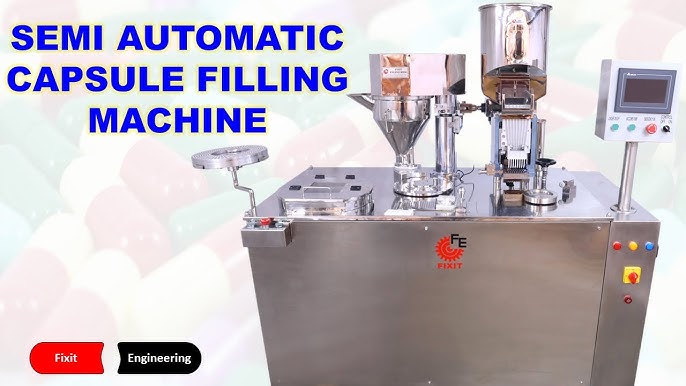
Capsule manufacturing is a core process in pharmaceutical, nutraceutical, and herbal industries, where precision and hygiene are essential. To achieve consistent dosage and efficient production, manufacturers rely on specialized equipment designed specifically for capsule filling operations.
A capsule filler machine is engineered to automate or semi-automate the process of filling empty capsules with powders, granules, or pellets. Its design and working mechanism are focused on ensuring accuracy, speed, and uniformity in every production cycle.
Basic Design of a Capsule Filler Machine
The design of a capsule filler machine is based on modular engineering principles that allow smooth operation and easy maintenance. Although configurations may vary depending on automation level, most machines share common structural components.
Key structural elements include:
- Capsule feeding system
- Capsule separation unit
- Powder or granule hopper
- Dosing mechanism
- Capsule locking and sealing unit
- Control panel and operating interface
- Collection tray or output system
Each part is designed to perform a specific function in the capsule filling cycle, ensuring coordinated and efficient production.
Capsule Feeding and Alignment System
The process begins with the capsule feeding system, where empty capsules are loaded into the machine. They are automatically oriented and positioned correctly for processing.
This system ensures:
- Proper alignment of capsule bodies and caps
- Smooth and continuous feeding of capsules
- Reduced manual handling errors
Efficient feeding is essential for maintaining uninterrupted production flow.
Capsule Separation Mechanism
Once aligned, capsules are separated into two parts: the body and the cap. This is typically done using vacuum-assisted or mechanical separation systems.
The separation mechanism is designed to:
- Hold capsules securely during splitting
- Prevent damage to capsule shells
- Prepare capsule bodies for filling
Accurate separation ensures smooth downstream processing.
Powder Dosing and Filling System
The dosing system is one of the most critical components of a capsule filler machine. It determines the accuracy and consistency of each capsule’s content.
Common dosing methods include:
- Auger-based filling systems
- Dosing disc mechanisms
- Vacuum-assisted powder filling
These systems ensure that each capsule receives a precise amount of material, reducing variation between units.
Capsule Closing and Locking Mechanism
After filling, the capsule bodies are rejoined with their caps using a locking mechanism. This step ensures that the capsule is securely sealed and ready for further processing or packaging.
The closing system:
- Aligns capsule halves accurately
- Applies controlled pressure for sealing
- Ensures proper locking without deformation
A reliable locking mechanism is essential for preventing leakage or damage during storage and transport.
Working Mechanism of a Capsule Filler Machine
The working mechanism follows a continuous and synchronized process designed for efficiency and accuracy.
Step-by-step operation includes:
- Feeding of empty capsules into the system
- Automatic separation of capsule bodies and caps
- Filling of capsule bodies with measured dosage
- Rejoining and locking of capsules
- Ejection of finished capsules for collection
Each stage is carefully timed to ensure smooth transition and consistent output.
Automation Levels in Capsule Filler Machines
Capsule filler machines are available in different automation levels, which influence their working mechanism.
- Manual systems: Require full operator involvement
- Semi-automatic systems: Combine manual loading with automated filling
- Fully automatic systems: Handle the entire process independently
Higher automation levels improve efficiency, reduce labor dependency, and enhance production speed.
Importance of Design in Performance Efficiency
The design of a capsule filler machine directly impacts its performance. A well-engineered system ensures:
- High production efficiency
- Consistent capsule quality
- Reduced downtime and maintenance
- Easy cleaning and operation
Design optimization is especially important in pharmaceutical environments where precision is critical.
Applications in Manufacturing Industries
Capsule filler machines are widely used across various industries due to their versatility and reliability.
Common applications include:
- Pharmaceutical drug production
- Nutraceutical supplement manufacturing
- Herbal and Ayurvedic product encapsulation
- Research and laboratory testing
Their adaptable design allows them to handle different formulations and production scales.
Conclusion
A capsule filler machine is a carefully engineered system designed to ensure efficient, accurate, and hygienic capsule production. Its structured design and synchronized working mechanism make it an essential tool in modern manufacturing environments.
By combining precise dosing, automated handling, and reliable sealing systems, the capsule filler machine supports high-quality production across pharmaceutical and nutraceutical industries. As demand for capsule-based products continues to grow, its role in efficient manufacturing remains increasingly important.
