

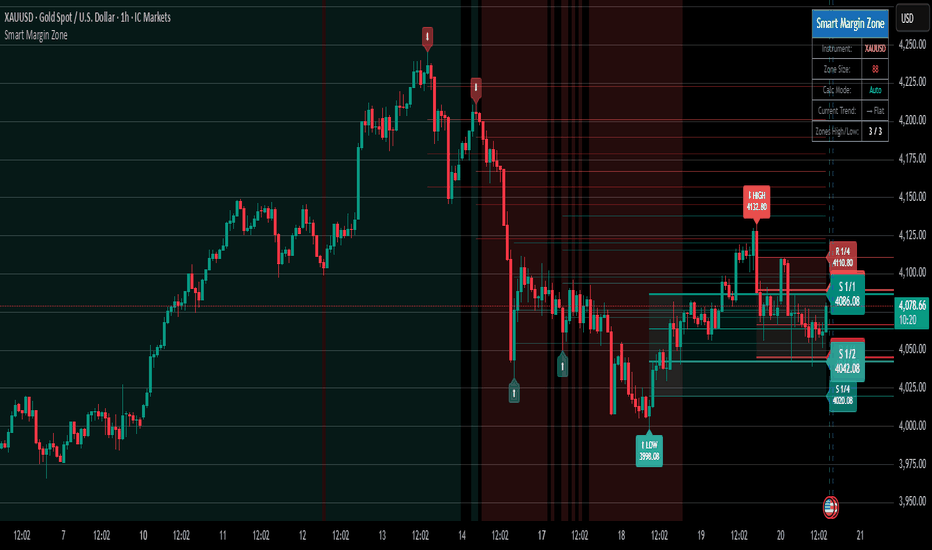
When trying to enter or exit positions at the best points, traders tend to place emphasis on identifying trend exhaustion where a current trend on the market could be losing momentum. TradingView charts give an interactive basis of identifying such turning points through the visualization of price action, trendlines and technical indicators. Through trend analysis, traders use the trend in terms of shrinking candlestick sizes, declining volume, or re-test of the levels of resistance and support to determine when the direction of the trend is going to reverse or move into the period of consolidation. This understanding assists in strategizing the entries, exits, and risk management in a better way.
It is also necessary to observe price action around the areas of significant support and resistance to identify the exhaustion of trends. As long as prices continue to fail to breach a level even when there is momentum that has been maintained, it may be an indication that there is a weakening conviction by the traders. The TradingView charts give the user an opportunity to mark these key areas so that they can predict when the trend will reverse or stagnate. The marks made on the charts can be easily identified as patterns of exhaustion before price action has indicated a reversal.
Another confirmation in identifying trend exhaustion is volume analysis. When the trend is strong and the volume decreasing, it is normally an indication of the momentum dying. With volume indicators overlaid on TradingView charts, traders can compare price movements with trading activity to assess trend strength. It is a combination of visual trendlines and volume data that increase the credibility of signals enabling traders to be ready against possible reversals or range-bound conditions.
The technical indicators also help in identifying the exhaustion of the trend. The Relative Strength Index, Stochastic or MACD are examples of oscillators that can draw attention to overbought or oversold markets and divergence, which may even indicate a change in momentum in trend. The TradingView charts provide the traders with a multi-dimensional view of the market behavior when they overlay the indicators with the price patterns. The integration enables traders to make wise decisions as opposed to basing their decisions on the observation of prices only.
Observing various intervals improves the precision of trend burnout. A trend can be seen as having been strong on a short term chart but signaling weakness on a long term chart. By establishing timeframes and analyzing them with the help of TradingView charts, the traders will be able to distinguish between a short-term pullback and a real reversal of the trend. This multi-layered method makes sure that the entry or exit will be founded on strong signals, as opposed to false signals of short durable change.
TradingView charts can be made more responsive with alerts on the charts when trends will start to burn. Traders are able to establish alerts to receive notifications when the price or indicator divergences or other custom condition is met. This will guarantee the knowledge in time and provides the ability to make prompt adaptations to the trading positions. Tips as well as visual chart analysis assist in keeping one on track and not miss out in changing market situations.
Past records come in handy where it can be established that a certain trend has been exhausted. By examining historical price behavior, marked up on TradingView, a trader can know the behavior of particular trends that have historically become inefficient. This visual record helps in the fine tuning of strategy, the best placement of stop-loss and take-profits and enhancing the entry and exit timing. With time, studying these trends develops the belief that one can identify the signs of exhaustion of a trend at an early stage.
A combination of trendline monitoring, volume, technical indicators, multi-timeframe comparison and TradingView chart alerts, offers a methodical way of identifying trend exhaustion. This systematic approach assists traders to predict possible reversals, risk mitigation and precision in trades. Regular trading in these tools leads to disciplined trading and builds capacity to trade in volatile markets in a confident manner.
